
DJ & sound system
Speakers at a party: stands, cables and volume without incident
To use speakers on stands without incident: place the stands on flat, firm ground, fully spread and away from walkways; tape the cables to the floor; plug each speaker into its own socket; keep the volume reasonable for your ears and for your neighbours. The rest can be sorted out during the evening.
This guide goes through these points for the RCF ART 912-A pair of speakers that Fox Rider rents in Lyon, on the speaker rental in Lyon page. The pair is rented on its own, without a subwoofer or a mixer, with its stands, covers and power cables; a microphone does not plug into it directly but goes through the Pioneer XDJ-RX3 console, with which you can add a Shure SM58 as an option, €5 per microphone per rental (two at most), XLR cable supplied and microphone stand free of charge. It is picked up in Lyon 3, with no shipping. Placement in the room is covered in another article: here, we deal with what can fall over, come unplugged, get wet or damage your ears.
The stands: flat ground, fully spread, away from walkways
Each speaker weighs 19.5 kg. Perched on a stand that tips over, it can injure someone or break. Set the stand on flat, hard ground. On soft grass, gravel or a slope, it sinks or slides: look for firmer ground, or put a wide board underneath.
Spread the legs of the stand completely, lock every adjustment, then shake it gently before mounting the speaker. Lift the speaker with two people: 19.5 kg at arm’s length, at head height, is when people get hurt or miss the mounting socket. Never adjust a stand with a speaker already on it.
Do not hang anything on the stand or the speaker: no string lights, bag or jacket. Do not let a walkway cross the space around a stand, or a corridor to the toilets or the buffet. A guest who is dancing and grabs a stand to steady themselves will knock it over: keep a clear zone around it, and mark it on the floor if needed. Outdoors, a tall speaker catches the wind like a sail: in gusts, lower it, lay it on a flat support or bring it inside.
Before the guests arrive, do a check round: stands upright, locks tight, cables secured, nothing sticking out at shoulder height. Do it again mid-evening, when the room has filled up and the layout has changed.
Cables and electricity
Each speaker has its own power cable, so its own socket. Do not plug them into a single power strip that is already loaded with the buffet, the coffee machine and the lights. Power strips must not be daisy-chained: a power strip plugged into another one can overheat.
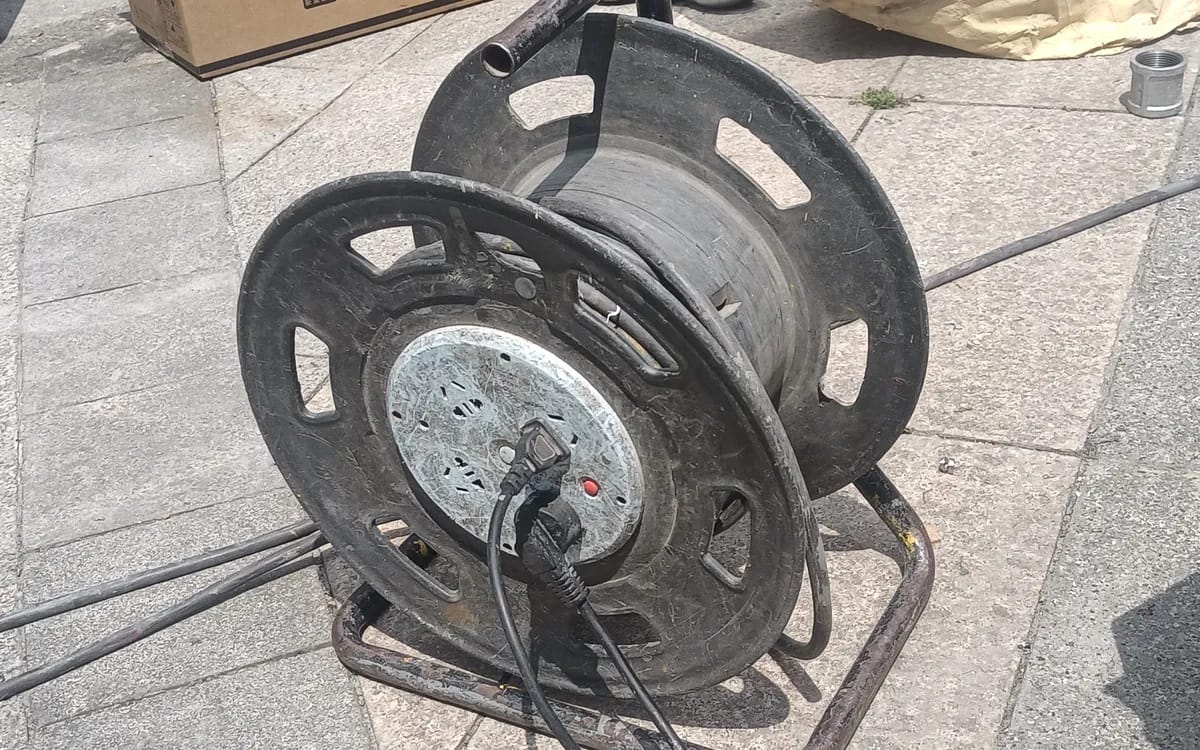
If you use a cable reel extension, unroll it completely: a cable left coiled heats up. Run the cables along the walls. Where they cross a walkway, tape them to the floor with wide tape, otherwise someone will trip on them and pull a speaker off its stand. Cross signal cables and mains cables at right angles rather than running them side by side, which limits hum.
To avoid a sharp pop in the speakers, turn all the volumes down before plugging in. When switching on, start with the source, then the speakers; when switching off, do the reverse. If a circuit breaker trips, switch everything off and reduce the load before resetting it.
Rain and humidity
RCF does not publish any waterproofing or ingress protection rating for this speaker. Treat it as indoor equipment: not in the rain, not on wet grass, not under the evening dew without shelter. The covers are there to protect the speaker while it is being moved; they are not protection against a downpour.
Plan a plan B before the party: a marquee, a covered terrace, a room to bring the equipment into. If rain starts, cut the power first, then move the speakers, never the other way round. For outdoor events, see also the article on sound equipment outdoors.
Your ears and your guests’ ears
The spec sheet states a maximum of 130 dB SPL at 1 m. That is loud enough to damage hearing. In a free field, the level drops by about 6 dB each time the distance doubles: people right next to the speakers get the loudest sound. Do not let children sit or dance against them, and keep the area in front of each stand clear.
Venues open to the public that play amplified sound must, according to the decree of 7 August 2017, stay within 102 dB(A) and 118 dB(C) at most over 15 minutes. A hired venue may be concerned: ask the manager. Even outside that framework, these are good benchmarks. A sound level meter, even a phone app, gives an idea, with no legal value. Whoever sets the sound protects themselves with earplugs.
A simple guide for a dinner: if guests have to shout to talk to each other at the table, the level is too high. On a dance floor, plan breaks without music and a quieter spot, away from the speakers, where people can chat and rest their ears. The level at the start of the evening does not have to be the level at the end.
The neighbours
The French Public Health Code (article R1336-5) prohibits any particular noise that, by its duration, repetition or intensity, disturbs the peace of the neighbourhood, by day or by night. So point the speakers away from homes, close the windows of the room, keep a moderate level near the facades and warn your neighbours before the party. For the overall organisation, see the article on organising a DJ event in Lyon.
More in this section
 DJ & sound system
Speaker pair: do you need a subwoofer, a mixer or a mic?
A pair of speakers, one source, and nothing else? When to add a mixer, a mic or a subwoofer, and what Fox Rider does or does not rent.
5 min read DJ & sound system
Transporting a pair of speakers by car
Measure the boot, wedge the speakers in their covers, carry them with two people, avoid heat and cold: the trip there and back, from pickup in Lyon 3 to return.
5 min read DJ & sound system
DVS: mixing digital on vinyl
DVS allows you to play your files while keeping your hands on real turntables. Here's how it works, what it actually costs, and the parts to remember.
4 min read