
DJ & sound system
Garden parties and picnics: playing music outdoors, and the rules
In France, the reference text for music at a garden party or picnic says nothing about times or decibels: it targets the disturbance caused to the neighbourhood, by day as well as by night. In a park, on a beach or on a riverbank, the rules of the place, or even a municipal order, come on top: that is where you read what is tolerated. A battery-powered speaker changes nothing: whether the sound comes from a mains socket or from a battery, the rules are the same.
This article gathers reference points, not legal advice: if in doubt, ask the town hall or the manager of the place. If you plan to rent a Soundboks 4, it is collected in Lyon 3 (no shipping), it is handed over with a charged battery, and a Shure SM58 microphone can be added as an option: €5 per microphone per rental, two at most, XLR cable supplied and microphone stand free of charge. The speakers to rent in Lyon are gathered on a single page.
What the French Public Health Code (Code de la santé publique) says
Article R1336-5 of the French Public Health Code sets out the principle: no individual noise may, through its duration, its repetition or its intensity, undermine the tranquillity of the neighbourhood, in a public or private place. Three criteria are cited, and any one of them can be enough:
- duration: music that goes on all afternoon;
- repetition: music that comes back every weekend;
- intensity: music that is too loud for the neighbours.
This text applies by day as well as by night. In practice, for a noise linked to behaviour, such as music, a sound level meter measurement is not needed to establish it. The penalty, set out in article R1337-7, is a 4th-class petty offence since 1 October 2023 (decree n° 2023-695). We give no amount: the main thing to remember is that the matter is taken seriously. This applies to a picnic as much as to a birthday in the garden: the place and the occasion do not change the principle.
Night-time disturbance: what the French Penal Code (Code pénal) says
At night, article R623-2 of the Penal Code comes into play: night-time noise or disturbance that upsets other people's tranquillity is a 3rd-class petty offence. An additional penalty is possible: confiscation of the item used to commit the offence. For a speaker, that means the speaker itself.
If it is rented, that is worth thinking about before turning the volume up after dark: the equipment is not yours. Nothing is automatic in this text, the penalty is only possible, but it is better not to tempt it.
No legal time, no threshold to remember
There is no legal time in France from which music becomes allowed or forbidden: “10 pm” is a habit, not a threshold in the law. What matters is the disturbance, by day as well as by night.
We do not give a decibel threshold for private individuals either. The useful benchmark is simpler: if your neighbours can hear it at home and complain, you are already in the territory of the rule. Three habits limit the risk:
- raise the volume in steps, rather than starting loud;
- keep some headroom: Soundboks states up to 126 dB at maximum, and there is no point in seeking that maximum in a garden;
- remember that in an open field the level drops by about 6 dB each time the distance doubles, which offers little protection to neighbours a few metres away.
Parks, beaches, riverbanks: each place has its own rule
In a park, each site has its own rules, generally displayed at the entrance. Read them before bringing a speaker. A checked example in Lyon: the rules of Gerland park, issued by order of the mayor, prohibit in article 14 disturbing noise, including noise produced by the use of sound-broadcasting devices, except when using headphones. Exemptions may be granted for authorised events.
So never assume that a park, a beach or a riverbank allows music: we claim nothing of the kind for any place. For beaches, riverbanks and public spaces, a municipal or prefectural order may regulate amplified music. The right approach is to ask the town hall of the municipality concerned, before you go, what applies at the exact spot you have in mind.
Private garden and rented venue
At home, article R1336-5 applies too: it covers a public or private place, and a Sunday afternoon does not set the rule aside. A few simple habits are generally enough:
- warn your neighbours beforehand, and tell them when the party ends;
- stand the speaker upright on the ground, facing your guests and not the house next door;
- look at what is behind it: outdoors nothing bounces the sound back, but a wall or a facade can send it back towards the audience and the neighbours;
- raise the volume in steps and lower it before the time you announced.
For a drinks reception or a garden party in a rented estate, the rules of the venue come first, including any sound limiter. Ask the organiser before booking the equipment, not the day before.
For setting up the equipment, read our article on stands, cables and volume at evening events. If your event grows, our guide to organising a DJ event in Lyon helps to frame what comes next. The rental lasts from 1 to 7 days; the price depends on the length of the rental and is shown on the product page, as is the security deposit, paid on site at handover and returned after a check on return if the speaker comes back in good condition.
More in this section
 DJ & sound system
Pairing several wireless speakers: TeamUp mode
A phone’s Bluetooth links one source to one speaker. Soundboks TeamUp makes up to five speakers play together: principle, settings and limits.
5 min read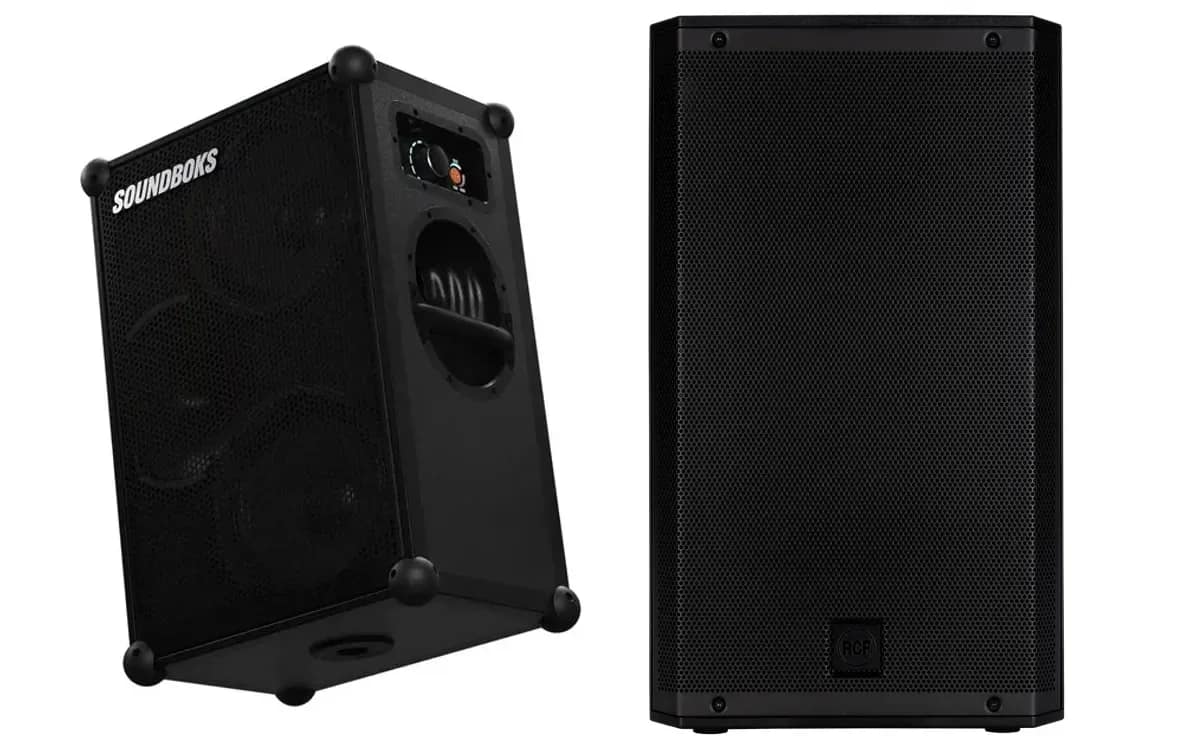 DJ & sound system
Battery speaker or wired pair: which one to choose?
One battery-powered speaker or two mains-powered ones? Five simple questions (socket, venue, source, transport, mood) to choose between the Soundboks 4 and the RCF pair.
5 min read DJ & sound system
IP65 speaker: rain, beach, boat, what it can handle
What does IP65 mean on a speaker? What Soundboks says exactly about the Soundboks 4: rain, beach, boat, and what it does not handle.
4 min read