
DJ & sound system
Active or passive speaker: what really changes
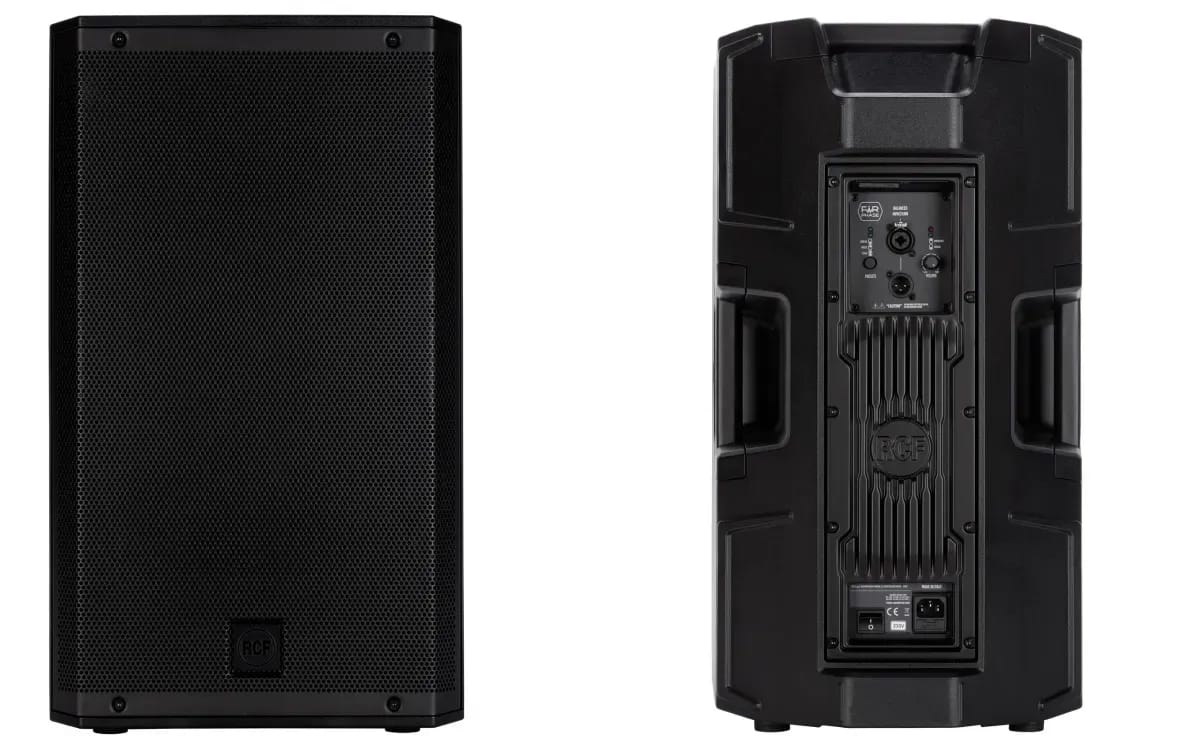
An active speaker contains its own amplifier: you plug it into the mains and the source, and it plays. A passive speaker does not: it needs a separate amplifier, connected by a speaker cable. For a party, an active pair is the simplest setup, and it is what Fox Rider rents: the pair of RCF ART 912-A speakers.
This guide explains the difference in plain terms, introduces the third family (the battery-powered portable speaker) and says what this choice changes in practice, from cabling to the power socket. The full offer is on the speaker rental in Lyon page.
Passive speaker: the amplifier is elsewhere
A passive speaker contains only the drivers and a crossover. The signal from a phone, computer or console is far too weak to move them. It therefore goes through an amplifier first, which sends power to the speaker over a speaker cable.
This adds things to find and set up: an amplifier, one speaker cable per speaker (different from the cable coming from the source), and an amp that matches the speakers in power and impedance. A bad match can damage the equipment, so it takes some basic knowledge.
That is not a flaw in itself. Passive speakers remain common in fixed installations and among technicians who want to choose each link in the chain. For a private individual setting up a sound system for a weekend, it is mostly one more source of mistakes.
Active speaker: the amplifier is inside
In an active speaker, the amp sits inside the cabinet. Two cables remain to connect: the power cable, one socket per speaker, and the signal cable coming from the source, in XLR or jack. There is no speaker cable and no amp to match.
The signal comes in through XLR or jack, as a balanced or unbalanced connection. A balanced connection copes better with long runs: it picks up less interference, which is why it is preferred as soon as the cable crosses a room.
The RCF ART 912-A is also bi-amplified: its two-channel class D amplifier dedicates one channel to the 12-inch woofer (1400 W for the low end) and the other to the 1-inch compression driver (700 W for the highs), split at 1800 Hz. That makes 2100 W peak per speaker. This figure is a peak, not continuous power: do not read it as a volume guaranteed all evening.
Each driver thus gets an amplifier chosen for it, and the overall tuning was done by the manufacturer. Cooling is by convection, with no fan: no airflow noise to hear during a quiet track.
The third family: the battery-powered portable speaker
In between there is the portable speaker: built-in battery, Bluetooth connection, a single unit to set on a table. It is active too, but it is meant for a different use.
It is enough for background music: a picnic, a few people sitting around, a room where people are talking at the same time. It is no longer enough once you want to get people dancing, fill a hall or carry the sound over a distance. A single sound source, bass limited by the size of the unit and a battery to keep an eye on: these are format constraints, not brand ones.
A simple question helps decide: do you want guests to hear the music, or to feel it? In the first case, a portable speaker may do the job. In the second, an active pair on stands is better suited.
A battery speaker has one advantage the rented pair does not: it needs no socket. If your venue has none, power becomes the first question; read setting up sound for an outdoor party without a power socket.
Why an active pair is the simplest for a private individual
Three reasons come from the construction. Nothing to match, since the amp and the drivers are designed together. Short cabling: two power cables, one source cable, and one XLR cable if you want to link the second speaker to the first, thanks to the XLR output provided for that purpose. Built-in protections: a soft limiter and thermal and RMS protections, which prevent damage to the equipment from a burst of volume.
Compare the two chains. Passive: source, signal cable, amplifier, two speaker cables, two speakers, plus the amplifier's socket. Active: source, signal cable, two speakers, two power sockets. Fewer devices, fewer cables, fewer things to forget in the trunk.
As for settings, four controls are enough: the volume, and three modes. Linear gives clarity, Boost more “loudness”, Stage serves as a stage monitor. To choose the cables and plug them in the right order, the article XLR, jack, RCA cables: connecting your sound system details each connector.
What the active pair does not do
It has XLR and jack inputs, but no Bluetooth, no RCA input and no mini-jack input: a phone needs a suitable cable, to be brought along. It requires one mains socket per speaker. It weighs 19.5 kg per speaker, 39 kg for the pair, stands excluded.
An active speaker does not make the evening louder by magic: the real level depends on the room, the distance and the music, as with any speaker. It simplifies the hookup, not the acoustics.
Finally, the pair is rented on its own: neither a subwoofer nor a mixer, and no amplifier, since it is built in. Its inputs expect a line-level signal: a microphone goes through the Pioneer XDJ-RX3 console, with which you can add a Shure SM58 as an option, €5 per microphone per rental (two at most), XLR cable supplied and microphone stand free of charge. Pickup is in Lyon 3, with no shipping. To choose with full knowledge, the technical sheet is on the page for the pair of RCF ART 912-A speakers.
More in this section
 DJ & sound system
Plugging a phone into speakers without Bluetooth
No Bluetooth or mini-jack on these speakers: the cable to bring, the single-connection variant and the phone settings for a party.
5 min read DJ & sound system
Speakers at a party: stands, cables and volume without incident
Flat ground, cables taped to the floor, one socket per speaker, no rain, protected ears, neighbours warned: safety rules for a pair of speakers at a party.
5 min read DJ & sound system
Speaker pair: do you need a subwoofer, a mixer or a mic?
A pair of speakers, one source, and nothing else? When to add a mixer, a mic or a subwoofer, and what Fox Rider does or does not rent.
5 min read