
DJ & sound system
XLR, jack, RCA cables: connect your sound system
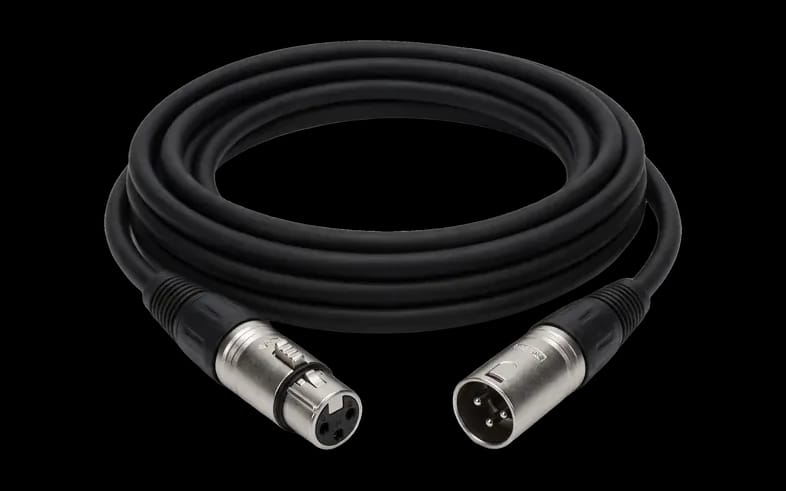 AI image · Gemini
Contents
You plugged everything in, and the system blows. Or worse, it hums, a low hum that doesn't go away when you lower the console volume. We often blame the speaker, sometimes the room. Nine times out of ten, it’s the cabling – and more precisely the choice between two families of connections that nothing distinguishes with the naked eye.
Know before you plan: DJ equipment cannot be shipped. He withdraws and goes in person to Lyon 3 (2 Impasse du Lutin, 69003 Lyon), by appointment. The excess of €200 is paid on site at the drop-off and returned to you on return.
See also: RCF speaker rental or pair of RCF speakers to rent.
Symmetrical and asymmetrical: the only distinction that matters
An unbalanced link carries the signal on a single conductor, with the shield serving as both feedback and protection. This is the case for the RCA and the two-point 6.35 jack. Simple, economical — and sensitive: any interference picked up on the path arrives directly in the signal.
A symmetric connection carries the same signal twice, in opposite phase, on two separate conductors, plus a ground. On arrival, the device subtracts one from the other: what is common to the two wires – therefore the parasites picked up en route – is canceled, while the useful signal is reconstituted. This is the principle of the XLR and the 6.35 TRS jack. The technical reference note signed by Rane puts it bluntly: the symmetrical connection was designed to be immune to these noise currents which can never be completely eliminated.

The three meter rule
The same note sets a concrete limit, and it is probably the most useful figure in this article: any unbalanced cable must remain under three meters. Beyond this, the unpleasant effects of ground loops are amplified.
Translate: a one meter RCA cord between a turntable and the console, no problem. A fifteen meter RCA cord to the speakers at the back of the room is an antenna. Over this distance, we systematically switch to XLR - even if the speaker accepts both. The RCF ART 912-A speakers we rent in Lyon take both kinds of connection, XLR or jack: see the RCF ART 912-A speaker pair.

The actual connectivity of a rented console
Nothing theoretical here: here's what you'll find on the back of the Pioneer XDJ-RX3 , and what each socket is for.
| Socket | Kind | Use |
|---|---|---|
| MASTER (XLR) | Symmetrical | To speakers, including long distance |
| MASTER (RCA) | Asymmetric | Towards a nearby amplifier, less than three meters |
| BOOTH | Jack 6.35 TRS | Cabin return, level separately adjustable |
| PHONO x2 | CAR | Entrance to vinyl turntables |
| LINE x2 | CAR | Entering a line-level reader |
| MIC 1 and 2 | XLR and 6.35 TRS jack | Micro speech and animation microphone |
| TO | RCA and 3.5 mini-jack | Telephone during breaks |
The point to remember: the console offers both master outputs. Choosing the RCA because you have a red and white cord on hand, when you have to cross a village hall, means giving yourself free breathing all evening.

Where exactly does snoring come from?
A ground loop appears when the grounds of two devices are connected in a second place that we had not anticipated: by the ground of the mains sockets, by the rails of a rack, by a chassis which touches another chassis. The current which then flows in this loop is added to the signal, and is heard as a low hum.
Three gestures, in this order:
- A single power strip. Console, turntables, preamps: everything on the same electrical line. This is the remedy that resolves the most cases.
- The ground wire of the boards screwed onto the dedicated terminal of the console, and tightened well.
- Symmetrical as soon as it gets longer. Switch to XLR between the console and the speakers, and separate the audio cables from the mains cables, without running them in parallel for several meters.
One last detail that technicians know well: an active speaker powered from a remote outlet, at the other end of a room, is a perfect candidate for the ground loop. If you can't bring the power supplies closer together, balanced bonding becomes mandatory, not optional.
The list to prepare before leaving
- Two male-female XLRs the length of the room, plus one backup.
- Two pairs of short RCAs for the plates Technics , ground wires included.
- A 6.35 TRS jack if you plan a cabin return.
- An XLR for the speech microphone, apart, never the same as the music.
- A mini-jack to RCA adapter for auxiliary input, and a long power strip.
That's five lines on a list, and it's the difference between a sound system that disappears behind the music and a sound system that you hear even when no one is playing.
See also: speaker rental in Lyon or two-speaker sound pack.
More in this section
 CC0 · Wikimedia CommonsDJ & sound system
Connect a vinyl turntable to a speaker
A turntable connected directly to a speaker gives a weak sound with no bass. It's not a fault: a step is missing, and it can be fixed in ten minutes the same evening.
4 min read DJ & sound system
Technics boards or Pioneer controller: which to rent?
It’s not a duel of equipment, it’s a choice of practice. Vinyl or digital all-in-one: what each requires and allows.
4 min read Photo: PattayaPatrol · CC BY-SA 4.0DJ & sound system
Create a lounge atmosphere with rental DJ equipment
Cocktail, opening, private party: create an elegant lounge atmosphere with the right DJ equipment and sound settings.
4 min read