
Action & 360 cameras
Battery life and overheating: the truth in 4K
This is the most common fear before a rental, and it is well-founded: no one wants to see their camera turn off in the middle of the descent or during the speeches. Good news, manufacturers publish precise figures. Less good news, these numbers describe conditions you will never encounter. Here's how to read them.
Official figures, as published
| Camera | Battery | Autonomy announced |
|---|---|---|
| GoPro HERO 12 Black | Enduro 1720mAh | 70 mins in 5.3K/60; 1 hour 30 minutes in 5.3K/30; more than 2h30 in 1080p/30 |
| GoPro HERO 11 Black | Enduro 1720mAh | 35 mins in 5.3K/60, before thermal cut-off |
| Insta360 X5 | 2400mAh | 93 mins in 8K/30; 135 mins in 5.7K/30; up to 208 mins in Endurance mode |
| Insta360 X4 | 2290mAh | 75 mins in 8K/30; 135 mins in 5.7K/30 |
First lesson, immediate: definition and cadence cost more than everything else. On a X5, going from 8K to 5.7K saves forty minutes. On a GoPro, going down from 5.3K to 1080p more than doubles the battery life. Before adding batteries to your cart, ask yourself if you really need the maximum resolution — the answer is often no, especially if the movie ends up on a phone.
Second lesson, less expected: the generation matters as much as the setting. In the same 5.3K/60 mode and under the same measurement conditions, GoPro quotes 70 minutes for the HERO 12 Black and 35 for the HERO 11 Black — and on the HERO 11, what stops the recording is not an empty battery, it is the thermal cut-off. If you shoot long takes in high resolution, take the HERO 12.
What these numbers don't say
Insta360 documents its measurement conditions: laboratory at 25°C, screen off, Wi-Fi on automatic, image assistance disabled, continuous recording. In other words, a camera placed on a table which films without stopping, without being manipulated.
In the field, you turn on the screen to check the framing, you connect the phone to show a shot, you start and stop twenty times. Every reboot costs, every wireless connection costs, screen on costs a lot. So count significantly less than the announced autonomy, and remember above all that these figures are used to compare the models with each other, not to plan a day.
Heat: what the manufacturers really write about
Official operating ranges are public, and they are narrower than you might imagine. GoPro indicates −10°C to 35°C for HERO 12 Black. Insta360 announces −20 °C to 40 °C for X4 as for X5.
Thirty-five degrees is the air temperature. A black camera fixed on a handlebar, stationary at a red light one August afternoon in Lyon, exceeds this value effortlessly. Add to it a sensor that works at 5.3K and a waterproof housing that prevents any evacuation, and the automatic cut-off arrives. It's not a breakdown, it's a protection.
Six gestures that postpone the break
- Turn off the rear screen between shots. It is the primary consumer, and a source of heat in itself.
- Turn off Wi-Fi when not transferring anything. Leaving the phone connected constantly for an entire day is the best way to waste battery power for nothing.
- Go down a notch in definition or cadence. This is the most effective lever of all, by far.
- Take the camera out of the waterproof case as soon as you are no longer in the water. The box is an oven.
- Look for airflow. A camera on a moving headset cools; the same camera in a closed pocket does not cool down.
- Film in short sequences. A three-minute take well started is better than a twenty-minute shot from which you will keep nothing, and which will have caused the camera to heat up.
The cold: the real surprise
We repeat everywhere that the cold drains the batteries. This is generally true, but the manufacturer data is worth reading.
Insta360 publishes cold room measurements for X5: approximately 88 minutes in 8K at 30 fps, both at 0°C and −20°C, compared to 93 minutes at room temperature. The loss is minimal, and this is excellent news for skiing.
At GoPro, the answer came from the battery itself: the Enduro battery, the one supplied with the HERO 11 and HERO 12 Black, is presented by the manufacturer as significantly improving performance in cold weather down to −10°C, and increasing recording times by up to 40% in moderate temperatures – a figure measured on a HERO 10 Black filming in 4K/120 at 25°C.
The real winter reflex does not change: keep spare batteries in an inside pocket, against you. A warm battery that is inserted at the last minute holds up much better than a battery that has spent two hours in a backpack.
How many batteries to add to your rental
- Half a day of cycling, hiking or sightseeing: the original battery is enough if you film in sequences. A second to sleep peacefully.
- A day of skiing or sports, from morning to evening: on a GoPro, two spare Enduro batteries at least; on an X4 or an X5, the single extra battery we offer, backed by a USB-C power bank. The cold, the screen and the restarts add up.
- A ten-hour wedding or event: as many as the camera allows — three extra Enduro batteries on a GoPro, only one on an X4 or an X5 — plus a USB-C external battery in both cases. An X5 recharges to 80% in about 20 minutes with a 30 W PD charger: the meal is your recharge window.
- Diving or snorkeling: one spare battery at least, two on a GoPro, because you won't open the case with wet hands and each change must be planned.
And a non-technical reminder: take a fast and sufficiently large microSD card. A camera that films in 8K fills a card long before it has drained three batteries.
We prepare every GoPro HERO 12 Black, every GoPro HERO 11 Black and every Insta360 X5 fully charged, and you add the extra batteries when choosing your dates: up to three additional Enduro batteries on a GoPro, only one on an X4 or an X5 — the USB-C power bank takes over from there. This is the best euro you will spend on this rental.
More in this section
 Action & 360 cameras
360 camera or action camera: which one to rent?
A 360 doesn't frame anything: it films everything and you frame it afterwards. An action camera does the opposite. The real test is how much time you have after filming.
7 min read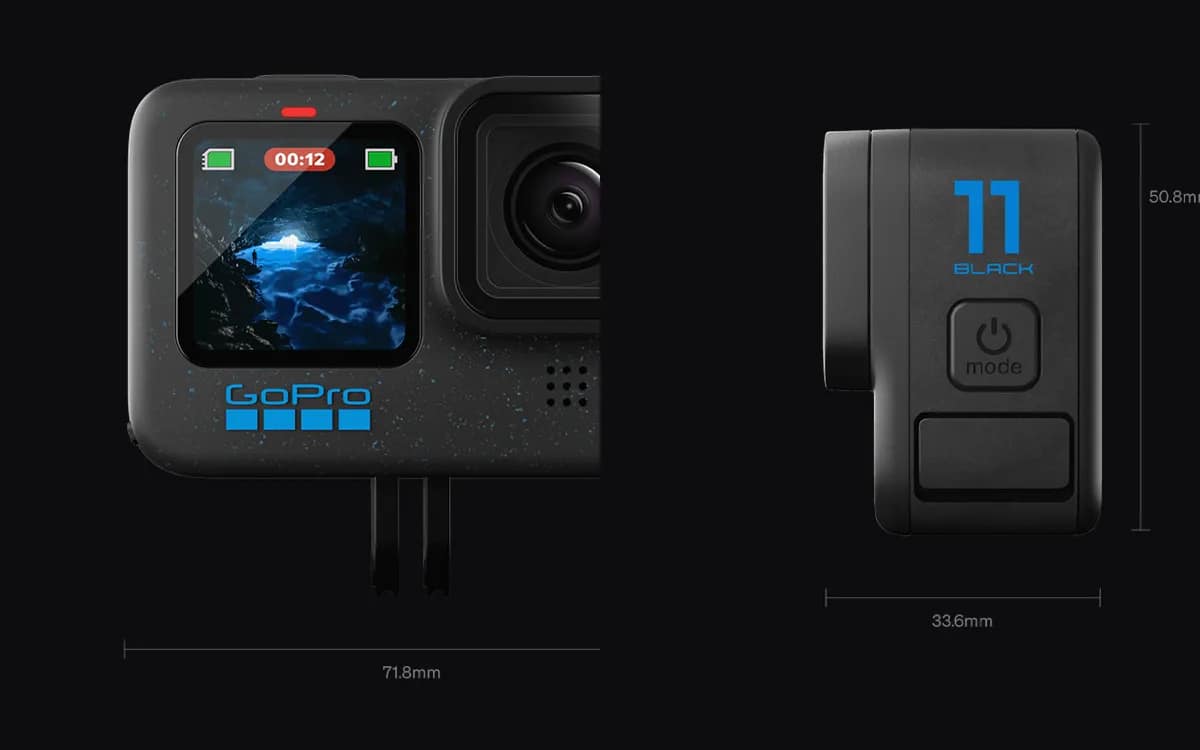 Action & 360 cameras
Which GoPro to rent depending on what you are filming
Same sensor, same housing, same waterproofing: these two GoPro cannot be distinguished in the image. They are decided on what you are going to film.
5 min read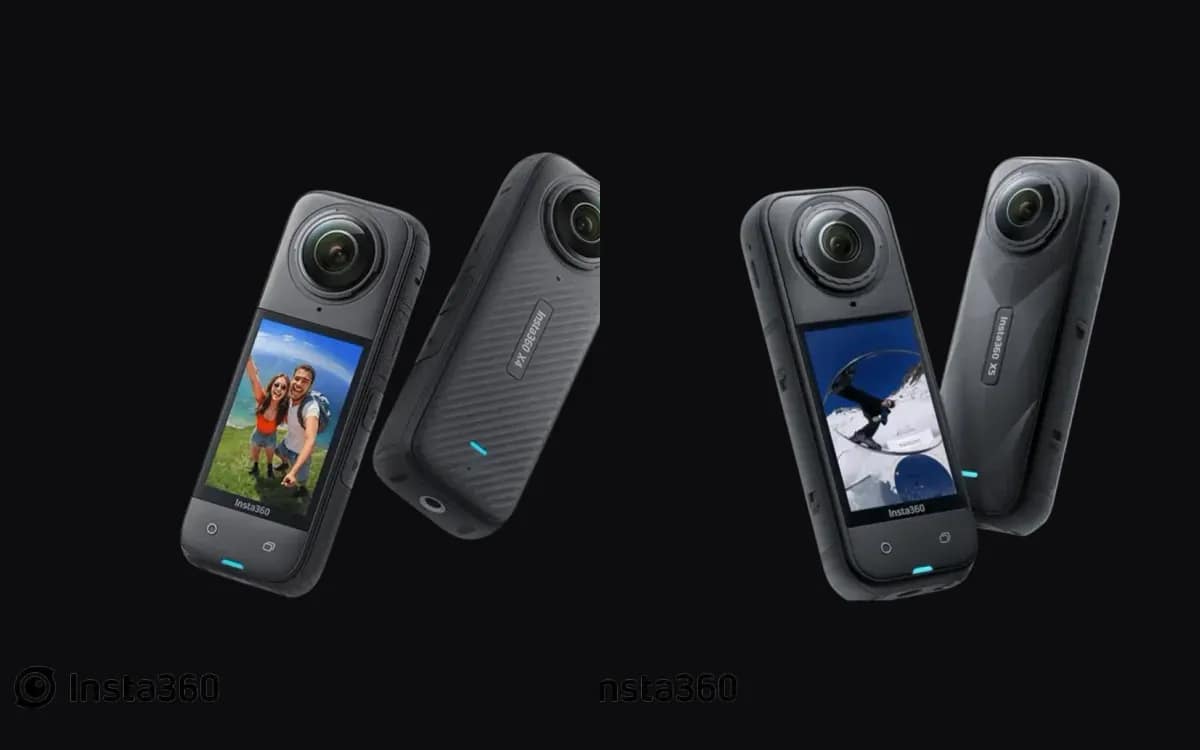 Action & 360 cameras
Insta360 X4 or X5: which 360 to rent, and for which shoot
Same maximum resolution, two very different cameras as soon as the light drops or a lens takes a knock. What moving from the X4 to the X5 actually changes.
5 min read