
Travel
Drone abroad: rules country by country

You have taken the online exam, registered your operator number, learned to read a zone map. And then you go abroad, and the question comes back intact: is all this still worth anything once you cross the border? The answer comes in two parts. In the European Union, yes, almost entirely. Elsewhere, you have to check destination by destination — and sometimes give up taking the drone.
In the European Union, your papers follow you
Since the entry into force of the European framework, a French recreational remote pilot does not have to retake an exam to fly in Spain, Italy or Portugal. The online training certificate – the 40-question exam that must be passed at 75% – is recognized in all Member States. The operator registration is done once, in your country of residence, and the resulting number is the one you stick on the device, wherever you fly in Europe.
Be careful, however, not to extend this reasoning yourself to all of geographical Europe. Several neighboring countries are not members of the Union and maintain their own requirements, published by their national authority. Before a weekend across a non-EU border, check directly with the civil aviation authority of the country concerned rather than assuming that your certificate is sufficient.
What “open category” actually means
Leisure flying is practiced in the open category, with identical rules from one European country to another. Three of them structure everything else:
- The ceiling is 120 meters above the ground, everywhere, without complacent exception.
- The flight is done in direct view of the aircraft, and never above gatherings of people.
- The subcategory depends on the class of the device: C0 remains under 250 g, C1 under 900 g, C2 under 4 kg, C3 and C4 under 25 kg. In subcategory A2, you must stay 30 meters away from people not involved, or 5 meters if the device has a low speed mode; in A3, the distance increases to 150 meters from people and urban areas.
In France, registration of the operator becomes mandatory beyond 250 grams, or as soon as the device embeds a sensor likely to collect personal data – which includes, in practice, all camera drones. The minimum age to be a remote pilot is set at 14 years, and electronic and light signaling is required above 800 grams.
Please note: the harmonized regulations do not remove national prohibited zones. Each country maintains its national parks, its military sites, its power plants, its regulated city centers. A common rule is not a universal authorization.

Outside of Europe, the rule really changes from country to country
This is where the unpleasant surprises concentrate, and they often occur even before the first flight: at customs.
The most documented case is Morocco. Drones are prohibited there, and specialized resources converge on the same observation: a device presented at the entrance to the territory is confiscated. It's not a fine or a warning, it's a seizure — with, for a rented device, a bill that looks like nothing you expected. In Cuba, the introduction of a drone faces the same type of blockage. In the Galápagos, flights are prohibited to protect endemic fauna. In Iran, use is severely restricted and carelessness can cost much more than a device.
Conversely, many destinations authorize leisure flights subject to a formality: online check-in, declaration on arrival, civil liability insurance certificate to be presented in the event of an inspection. Nothing insurmountable, provided you have anticipated it and not discovered it at the airport.
The method, one week before departure
- Identify the civil aviation authority of the country you are visiting and read its page on unmanned aircraft — this is the only authoritative source.
- Cross-reference it with the travel advice from the Ministry of Foreign Affairs, which advises on customs restrictions.
- If the two sources do not match, or if you cannot find anything, consider it prohibited and leave the drone at home.
- Carry a printed version of your certificate, your operator registration and your insurance: a check can be completed much faster with paper than with a phone with 4% battery.
- Finally check local areas before every flight, not just before travel.
Why a device weighing less than 250 g makes life easier — without guaranteeing anything
A lightweight drone doesn't make you legal everywhere, and no article should lead you to believe otherwise. On the other hand, it reduces the number of doors to knock on: fewer class constraints, fewer imposed distances, space that fits in cabin baggage. This is exactly the segment on which we have built our range.
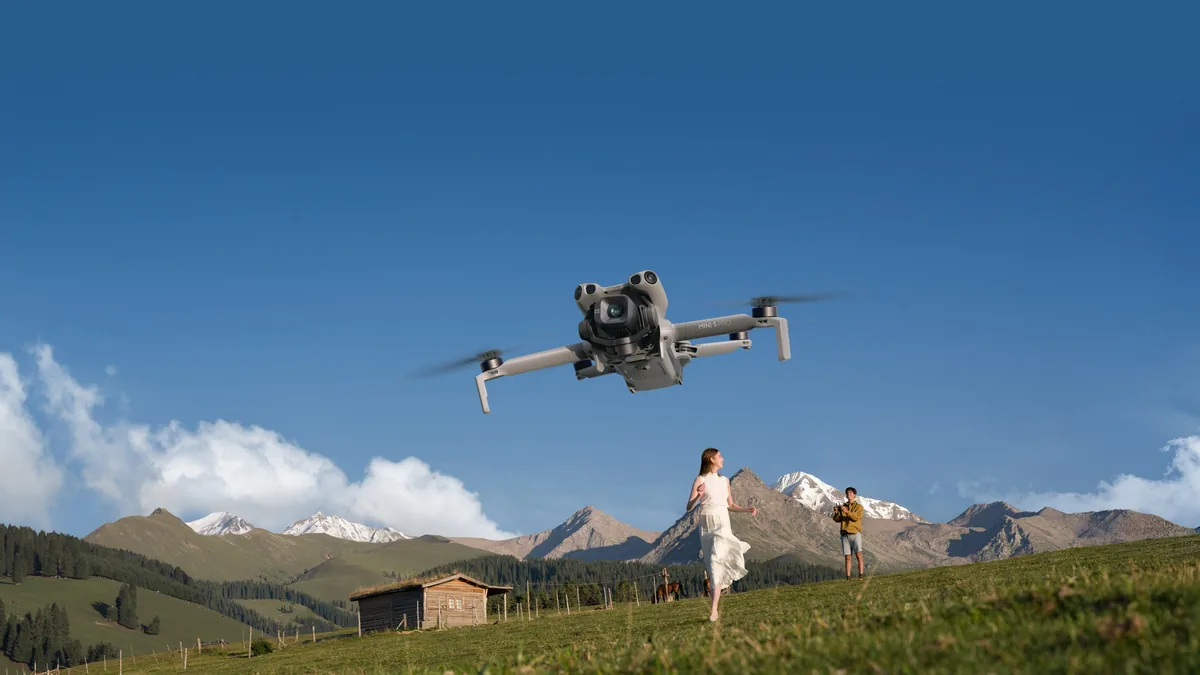
The DJI Mini 4 Pro announces a takeoff weight of less than 249 grams, a 1/1.3 inch 48 megapixel sensor and up to 34 minutes of flight with its standard battery. The DJI Mini 5 Pro remains on the same logic, at 249.9 grams, with a 1-inch 50-megapixel sensor opening at f/1.8 and up to 36 minutes of flight. Two devices designed for travel, which you return on your return rather than letting them sleep for eleven months a year.
And for destinations where drones are prohibited: don’t rent it, don’t take it, don’t try anything. An action camera in the bag will bring back better images than a drone confiscated on arrival.
More in this section
 Travel
Summer 2026 guide: what equipment to rent for your vacation
Summer 2026 is approaching: cameras, drones, DJ equipment... Discover our selection of equipment to rent for an unforgettable vacation.
5 min read Travel
The best camera settings for filming while traveling
Filming while traveling means bringing back much more than photos: it means capturing the movement, the atmosphere, the emotion of a moment that you […]
3 min read Travel
Equipment rental for a travel vlog: what budget should you budget?
Bring back images worthy of a film from a trip, without being weighed down by a backpack full of equipment out of […]
3 min read