
Drones
DJI Air 3S or Mini 5 Pro: which one to choose?
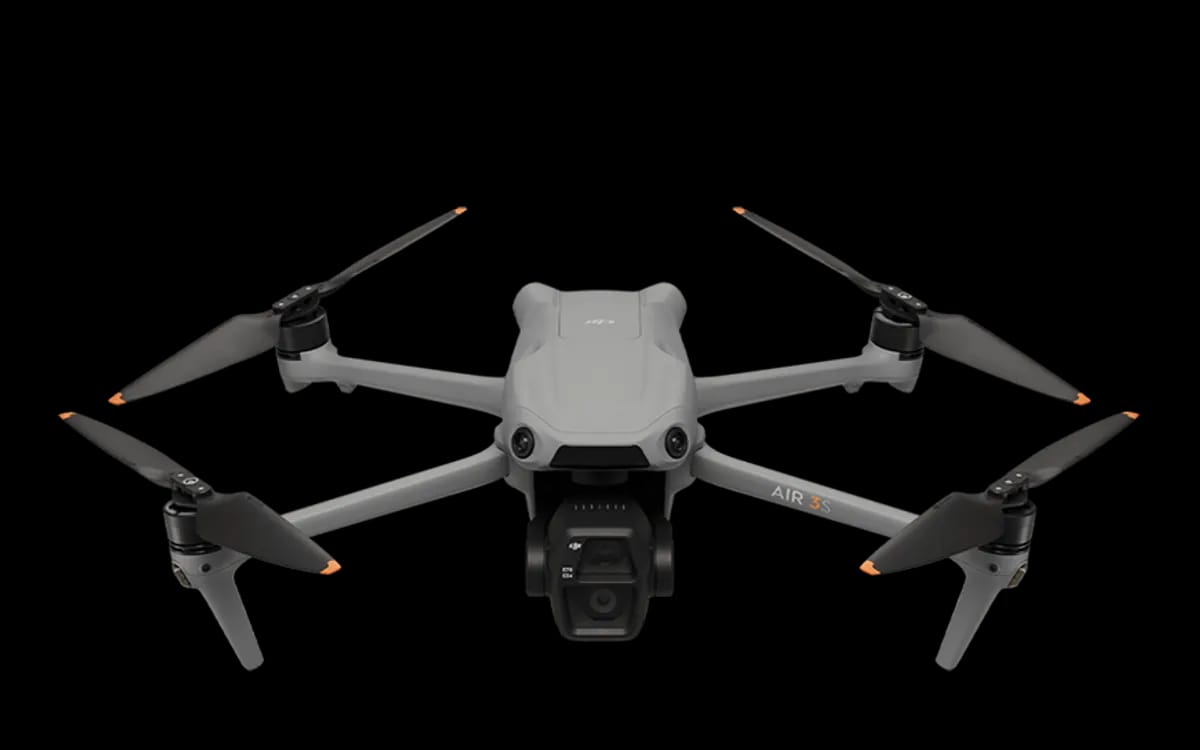
Since the DJI Mini 5 Pro has a 1-inch sensor, the comparison with the Air 3S has become legitimate. The two devices in fact share the same main sensor format. The question is therefore no longer “which one has the best image” but “what do 474 grams more give me, and what do they take away from me”.
At Fox Rider: rent the DJI Mini 5 Pro — damage & theft cover included, €250 deposit, delivered 24 h ahead.
Same sensor, two different devices
The Air 3S opens its wide-angle to a 1-inch 50 MP sensor in 24 mm equivalent to f/1.8. The Mini 5 Pro does the same: 1-inch 50 MP sensor, 24 mm equivalent, f/1.8. Both film in 4K up to 120 fps and have front-facing LiDAR in addition to their obstacle detection. On the main optical level, the actual difference is small.
The difference in mass, on the other hand, is brutal: 724 g versus 249.9 g.
The real plus of the Air 3S: the second focal length
This is the argument that justifies the extra weight, and the only one that cannot be avoided. The Air 3S has a second 70mm telephoto camera equivalent to f/2.8, on a 1/1.3 inch 48 MP sensor. A true optical telephoto lens, not a digital crop.
Concretely, this changes three things: you compress the mountain shots, you detach a subject from its background, and you film a building or a boat from further away, therefore more discreetly. If your project is based on these plans, no sub-250 g will replace them.
The Air 3S also adds 45 minutes of announced autonomy, compared to 36 minutes for the Mini 5 Pro. Both are given for 12 m/s of wind resistance and 10 km of range in CE standard.
What class C1 takes away from you
Here's the part that the comparisons forget. Weighing 724 g, the Air 3S bears the European marking C1. The Mini 5 Pro, at 249.9 g, remains in C0. Both fly in subcategory A1 of the open category, but the rules are not the same.
| Mini 5 Pro (C0) | Air 3S (C1) | |
|---|---|---|
| Takeoff weight | 249.9g | 724g |
| Overview of uninvolved people | possible, to be avoided as much as possible | not to do, tolerated if it is accidental |
| Overview of a gathering | forbidden | forbidden |
| Autonomy announced | 36 mins | 45 mins |
| Second focal length | No | 70mm telephoto lens |
In short: on a village square, a busy path or a wedding venue, the C0 gives you a margin that the C1 does not give you. Add the volume in the bag and the more imposing presence of a 724g device, which attracts attention where a Mini goes unnoticed.
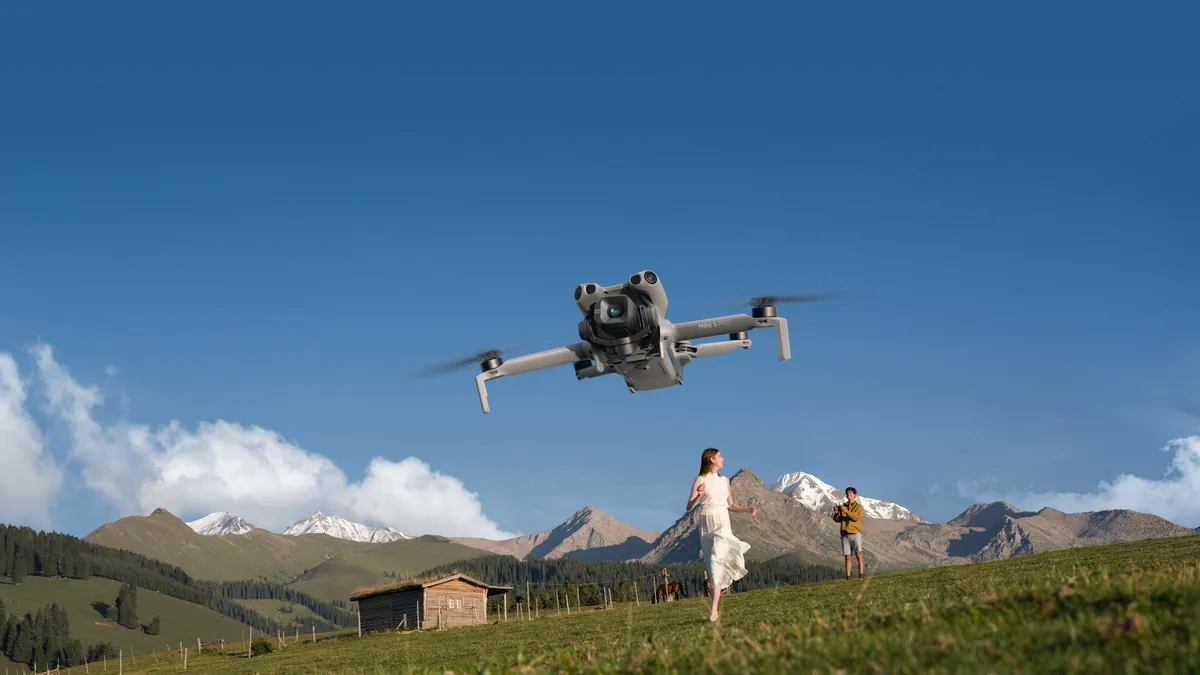
Size, discretion and safety in flight
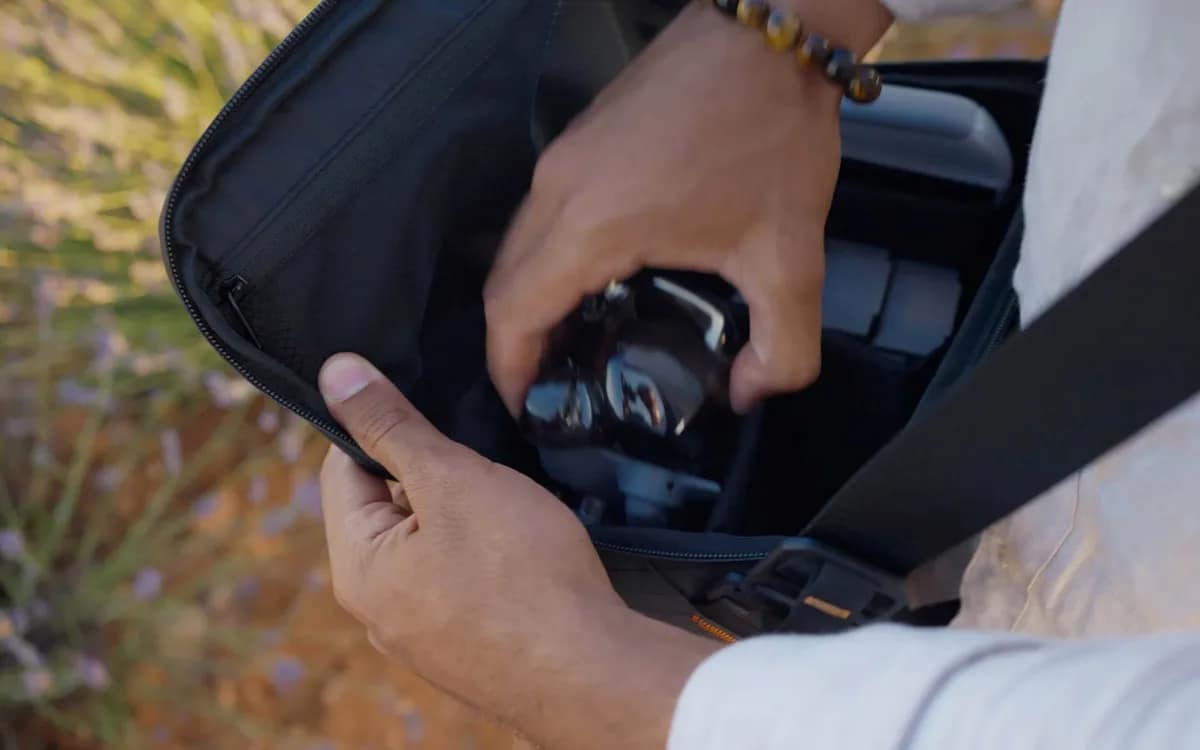
A 724 g drone does not fit in the same pocket as a 250 g device. This seems trivial until you have to walk two hours to reach a viewpoint, or spend a day in town with the equipment on your back. Added to this is a less measurable but very real effect: a Mini is forgotten, an Air attracts attention and questions.
In terms of security, both devices are well armed. The Air 3S combines omnidirectional obstacle detection, front-facing LiDAR capable of range up to 25m at night and a downward infrared sensor. The Mini 5 Pro uses the same logic – vision in all directions, LiDAR at the front, infrared on the ground. The Mini 5 Pro adds a gimbal capable of rolling from −180° to 45°, or 225° of amplitude, to film vertically without cropping.
Our verdict, and what we praise
The Air 3S is not in the Fox Rider catalog. We're saying it bluntly rather than letting you get to the basket: if your filming requires an optical telephoto lens — landscape compression, remote prestige real estate, wildlife tracking — the Air 3S is what you need, and we don't have it.
For everything else, that is to say the vast majority of rentals, the DJI Mini 5 Pro gives the same 1-inch sensor, the same 4K/120, the same LiDAR and the same wind resistance, in a more permissive regulatory class and a size that fits in a backpack pocket. If budget matters and you are filming in bright light, le Mini 4 Pro remains a serious alternative with its 1/1.3 inch sensor and 34 minutes of battery life.
More in this section
 Drones
Drone autonomy: how many batteries?
The technical sheets announce 34 or 36 minutes. Here's where these figures come from, what's left on the ground, and how many batteries to take.
4 min read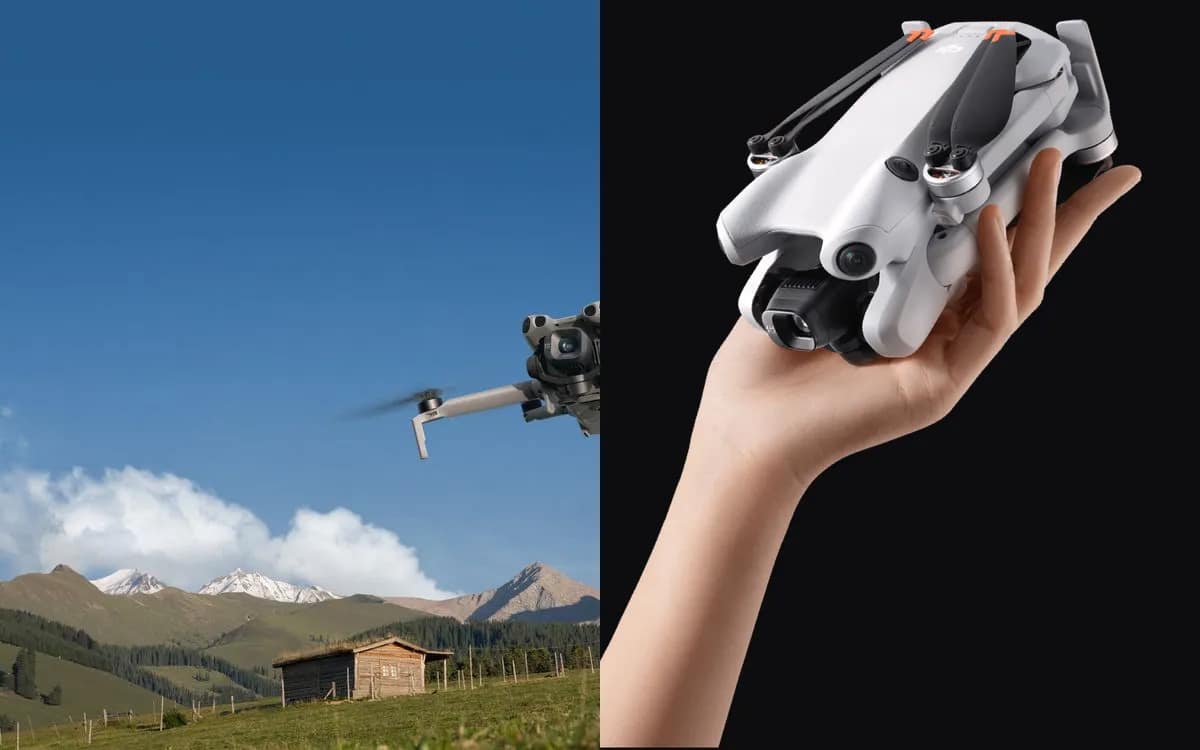 Drones
Which drone to rent depending on what you are filming
Two DJI Minis a generation apart. The choice comes down to three things: the declared weight, the light you will have, and the wind it will make.
4 min read Drones
DJI Mini 4 Pro or Mini 5 Pro: which for your holiday?
Two drones under 250 g. The full table, then what matters on holiday: wind, evening light, mountains, flying and going abroad.
8 min read